If you have a chipped tooth, stubborn discoloration, a small gap, or a slightly misshapen tooth, you have probably come across two treatment options more than any other: dental bonding and porcelain veneers. Both are popular, effective cosmetic dental procedures — and both can dramatically improve the appearance of your smile. But they are not the same thing, and choosing the wrong one for your situation can mean unnecessary expense, more invasive treatment, or results that do not hold up the way you expected.
This guide breaks down exactly what each treatment does, how they compare across every key factor — cost, durability, procedure time, candidacy, and more — and how to know which one is the right starting point for your smile goals. By the end, you will have a clear picture of what to discuss with Dr. Mitchell Sable at Smile Brightly Dentistry in Warren, MI.
What Is Dental Bonding?
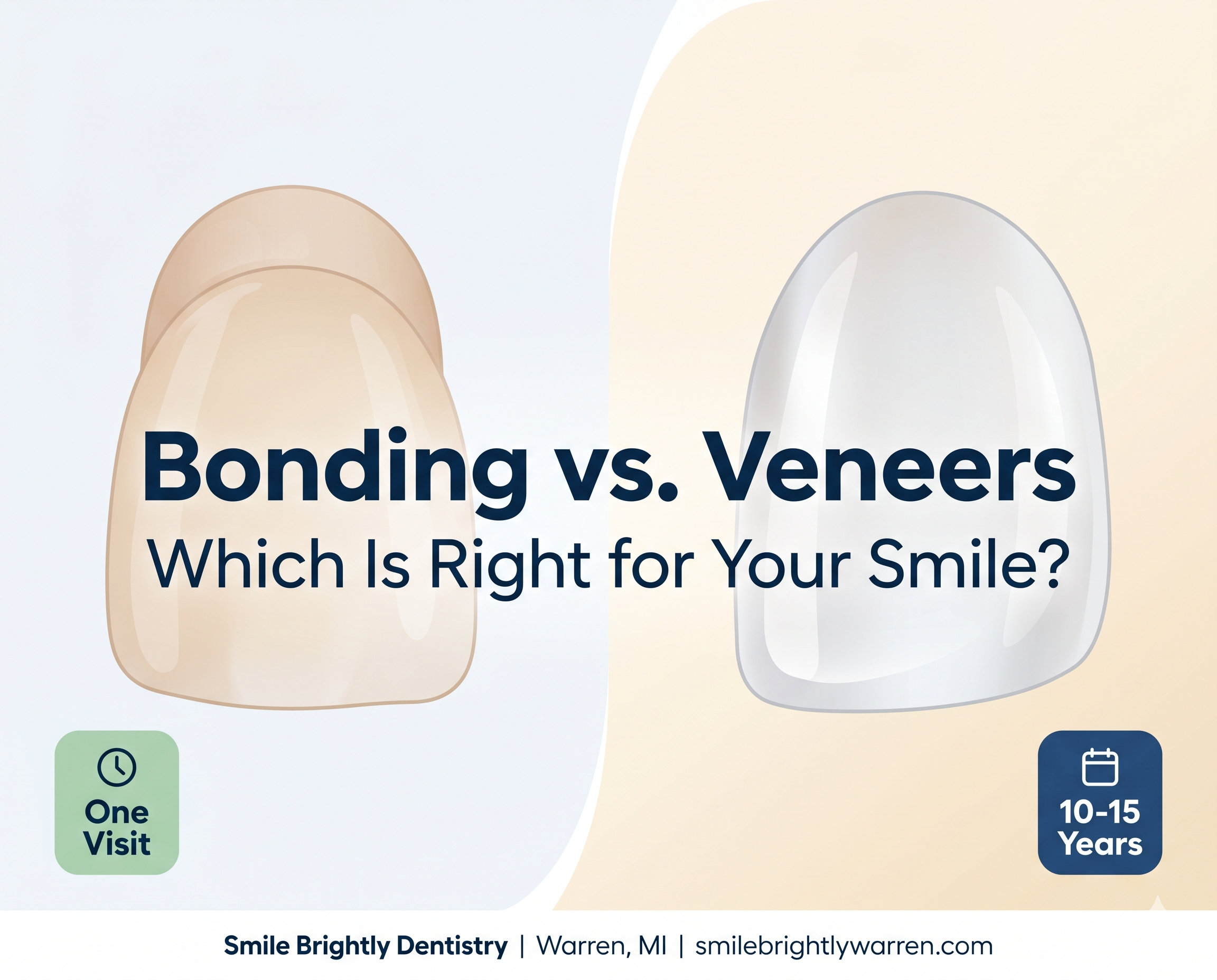
Dental bonding is a cosmetic procedure in which a tooth-colored composite resin is applied directly to the surface of a tooth, sculpted into shape, and hardened with a special curing light. The entire process is completed chairside in a single visit and typically requires little to no removal of natural tooth enamel.
Bonding is one of the most versatile tools in cosmetic dentistry. It can be used to:
- Repair chipped or cracked teeth
- Cover stubborn stains or discoloration that whitening cannot address
- Close small gaps between teeth
- Reshape teeth that are too short, too narrow, or slightly misshapen
- Cover exposed root surfaces caused by gum recession
- Protect a sensitive area of a tooth
Because the resin is matched to the shade of your surrounding teeth, bonding results look natural and blend seamlessly with your existing smile. A single tooth typically takes 30 to 60 minutes from start to finish.
What Are Porcelain Veneers?
Porcelain veneers are ultra-thin, custom-fabricated shells made from dental-grade ceramic that are permanently bonded to the front surface of a tooth. Unlike bonding, veneers are created in a dental laboratory and require at least two appointments — one to prepare the teeth and take impressions, and a second to bond the finished veneers in place.
To accommodate the thickness of a veneer, a thin layer of enamel — typically around 0.5mm — must be permanently removed from the front of the tooth. This makes veneers an irreversible procedure. Once you have veneers, you will always need some form of restoration on those teeth.
Veneers are an excellent option for patients who want to address:
- Severe or deeply set tooth discoloration that cannot be corrected with whitening or bonding
- Multiple teeth with chips, cracks, or uneven shapes
- Slightly crooked or misaligned teeth without the need for orthodontics
- Worn-down teeth that have lost their shape over time
- A complete cosmetic smile makeover involving six to ten or more teeth
Smile Brightly offers both porcelain and resin veneers in Warren, MI. Dr. Sable will help you understand which material and which treatment path makes the most sense for your specific goals and dental health.
Dental Bonding vs. Veneers: A Side-by-Side Comparison
Here is a direct comparison of both treatments across the factors that matter most to patients:
|
Dental Bonding |
Porcelain Veneers |
|
|
Cost |
Lower — more affordable upfront |
Higher — lab fabrication adds cost |
|
Procedure time |
One visit, 30–60 min per tooth |
Two or more visits required |
|
Enamel removal |
Minimal to none |
Small amount removed permanently |
|
Longevity |
3–10 years with proper care |
10–15+ years |
|
Stain resistance |
Moderate — can discolor over time |
High — porcelain resists staining |
|
Repairability |
Easy to repair or touch up |
Replacement required if damaged |
|
Best for |
Minor chips, cracks, gaps, discoloration |
Multiple teeth, severe discoloration, complete smile makeover |
|
Reversibility |
Fully reversible |
Not reversible — enamel removal is permanent |
Cost: How Do Dental Bonding and Veneers Compare?
Cost is one of the most significant practical differences between the two treatments — and bonding has a clear advantage for budget-conscious patients.
Dental bonding is one of the most affordable cosmetic dental procedures available. Because it is completed entirely chairside in a single visit using composite resin material, overhead and lab costs are minimal. Most dental insurance plans do not cover purely cosmetic procedures, but bonding used for restorative purposes — repairing a chip or covering an exposed root — may be partially covered depending on your plan.
Porcelain veneers require custom laboratory fabrication, which adds significant cost per tooth. A full smile makeover involving multiple veneers represents a considerable investment. While veneers tend to last longer than bonding, which partially offsets the cost difference over time, the upfront financial commitment is substantially higher.
For patients in Warren and the surrounding communities who want to improve their smile without a major financial investment, dental bonding is often the smartest first step. Call Smile Brightly Dentistry at 586-573-7700 to discuss your options and get a personalized estimate.
Durability: How Long Does Each Treatment Last?
Dental Bonding Lifespan
With proper care, dental bonding typically lasts between three and ten years before a touch-up or replacement is needed. The wide range reflects the significant role that patient habits play in longevity. Bonding material is durable enough for everyday use but is more susceptible to chipping and staining than porcelain.
Habits that shorten the lifespan of bonding include:
- Biting fingernails or chewing on pens
- Chewing ice or very hard foods
- Grinding or clenching teeth (bruxism)
- Consuming heavy staining foods and drinks such as coffee, red wine, and tea without rinsing afterward
The good news is that bonding is easy and inexpensive to repair. If a bonded tooth chips or the resin discolors over time, your dentist can often touch it up in a single short appointment without replacing the entire restoration.
Porcelain Veneers Lifespan
Porcelain veneers are significantly more durable than composite resin bonding and typically last ten to fifteen years or longer with proper care. Porcelain is highly resistant to staining and does not discolor the way composite resin can over time.
However, if a veneer chips or cracks, it generally cannot be repaired — it must be replaced entirely, which adds to the long-term cost of maintenance.
Patients with bruxism (teeth grinding) should discuss this with Dr. Sable before getting veneers, as grinding places excessive force on the thin porcelain shells and can shorten their lifespan significantly. A custom night guard is often recommended for veneer patients who grind their teeth.
Procedure: What Does Each Treatment Involve?
The Dental Bonding Procedure
One of the biggest advantages of dental bonding is its simplicity. Here is what a typical bonding appointment at Smile Brightly looks like:
- Your dentist selects a composite resin shade that closely matches your natural tooth color
- The surface of the tooth is lightly roughened and a conditioning liquid is applied to help the resin adhere
- The composite resin is applied, shaped, and sculpted to the desired form
- A curing light hardens the resin in place within seconds
- The bonded tooth is polished to match the sheen of your surrounding teeth
The entire process for a single tooth typically takes 30 to 60 minutes. Most patients require no anesthesia unless the bonding is being used to treat decay near a nerve. You can eat, drink, and return to normal activities immediately after your appointment — with one caveat: avoid coffee, tea, red wine, and other staining foods and beverages for the first 48 hours while the resin fully cures.
The Porcelain Veneer Procedure
Getting porcelain veneers is a more involved process that unfolds across multiple appointments:
- Consultation and treatment planning: Sable evaluates your teeth, discusses your goals, and develops a customized plan
- Tooth preparation: A thin layer of enamel is permanently removed from the front of each tooth to make room for the veneer — local anesthesia is used for comfort
- Impressions: Digital scans or physical impressions of your prepared teeth are sent to a dental laboratory where your custom veneers are fabricated
- Temporary veneers: In most cases, temporary veneers are placed while you wait for your permanent restorations — typically one to two weeks
- Final bonding: Your finished porcelain veneers are tried in, adjusted for fit and color, and permanently bonded to your teeth
Because enamel removal is permanent, the decision to get porcelain veneers should be made thoughtfully. This is a long-term commitment — but for the right patient with the right goals, the results can be transformative and last well over a decade.
Which Treatment Is Right for You?
The honest answer is: it depends on what you are trying to fix, how many teeth are involved, and what your budget and timeline look like. Here is a practical framework to help you think it through:
Dental Bonding May Be the Better Choice If:
- You have one or two teeth with minor chips, cracks, or discoloration
- You want results in a single appointment
- You are working within a tighter budget
- You want a reversible treatment that preserves maximum natural tooth structure
- You are considering whitening first and want to match your bonding to a brighter shade
- You are younger and may want to reassess your smile goals in the future
Porcelain Veneers May Be the Better Choice If:
- You want to address multiple teeth at once for a comprehensive smile transformation
- You have severe discoloration that bonding or whitening cannot fully correct
- You want a longer-lasting result with superior stain resistance
- You have teeth that are significantly worn, chipped, or uneven across your smile
- You are prepared for the permanent nature of enamel removal
- You want the most natural-looking, durable cosmetic result available
It is also worth noting that bonding and veneers are not always an either-or decision. Some patients use bonding as a first step — to fix an urgent cosmetic concern affordably — and then transition to veneers later when they are ready for a more comprehensive result. Others combine treatments, using veneers on the most visible teeth and bonding elsewhere.
The best way to know which treatment is right for your smile is to schedule a consultation with Dr. Sable at Smile Brightly in Warren, MI. He will evaluate your teeth, listen to your goals, and give you an honest recommendation — with no pressure. Call 586-573-7700 or visit smilebrightlywarren.com to book your appointment.
An Important Note About Whitening and Bonding
One thing many patients do not realize until after the fact: composite resin used in bonding does not respond to teeth whitening. This means that if you whiten your teeth after getting bonding done, your natural teeth will brighten but the bonded tooth will stay the same shade — creating a visible color mismatch.
For this reason, the recommended sequence is always to whiten first, then bond. This allows Dr. Sable to match the resin to your new, brighter tooth shade so everything blends naturally from day one. The same principle applies to veneers — any whitening treatment should be completed before veneers are placed.
If you are considering both whitening and bonding, mention this at your consultation and Dr. Sable will help you plan the right sequence for your specific situation.
How to Care for Bonded Teeth
Dental bonding is easy to maintain with a few straightforward habits:
- Brush twice daily with a soft-bristled toothbrush and non-abrasive toothpaste
- Floss daily to keep the margins of the bonding clean
- Avoid biting fingernails, chewing ice, or using your teeth to open packages
- Limit heavy staining foods and beverages, especially in the first 48 hours after treatment
- Wear a night guard if you grind your teeth
- Schedule regular cleanings and exams at Smile Brightly so Dr. Sable can monitor the bonding over time
With good oral hygiene and mindful habits, bonding can last toward the upper end of its lifespan and continue looking natural for many years.
Dental Bonding and Veneers at Smile Brightly Dentistry in Warren, MI
At Smile Brightly Dentistry, Dr. Mitchell Sable takes an individualized approach to every cosmetic case. He understands that no two smiles — or smile goals — are the same. Whether you are looking for a quick, affordable fix for a chipped front tooth or a complete smile transformation with porcelain veneers, Dr. Sable will walk you through your options honestly and help you make a confident, informed decision.
We welcome patients from Warren and the surrounding communities at our conveniently located office at 11270 E Thirteen Mile Rd Suite 1a, Warren, MI 48093.
Ready to take the first step toward a smile you love? Call 586-573-7700 or visit smilebrightlywarren.com to schedule your cosmetic consultation today.